
Bioinformatics Analysis Services
Your data. Our expertise.
Clearer answers.
Work with experienced scientists to analyze your proteomics, transcriptomics, and multiomics data, interpret findings, and deliver results your team can explore.
Discuss your analysis project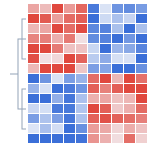
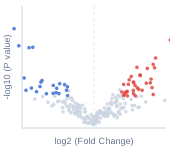
| Gene | log2FC | P value | FDR |
|---|---|---|---|
Get the support your research needs.
Additional analysis capacity
Move your project forward when your team needs support.
Expertise for a new method
Get help with unfamiliar methods or data types.
Deeper dataset exploration
Investigate new questions in data you already have.
Omics data analysis built around your scientific questions.
Proteomics
Explore protein abundance and biological patterns in DIA and DDA data.
Transcriptomics
Investigate gene expression in bulk RNA-seq, single-cell, and microarray data.
Targeted profiling
Interpret focused expression datasets, such as nCounter and Olink panels.
Multiomics
Connect proteomics, transcriptomics, and other complementary data types.
Additional analysis capabilities.
Differential expression
Identify and interpret changes across conditions.
Pathway and enrichment analysis
Explore biological pathways and functional context.
Public dataset reanalysis
Leverage public datasets to investigate new questions.
Experiment design support
Get input on study design, comparisons, and analysis strategies.
From your research question to interpretable results.
- 1
Define the question
Discuss study goals and priorities.
- 2
Review data and scope
Agree on methods, deliverables, and timeline.
- 3
Analyze and discuss
Review findings and refine the questions.
- 4
Deliver and explore
Walk through results and next steps.
Results you can use and share.
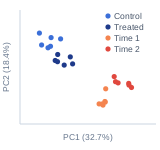
Clear, interactive results and accompanying deliverables to help you interpret and communicate your findings.
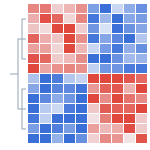
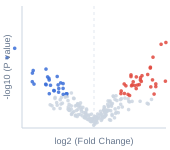
| Gene | log2FC | P value | FDR |
|---|---|---|---|
-
Understand data quality
Identify issues that affect interpretation.
-
Understand the findings
Connect analysis to your scientific question.
-
Continue exploring
Review interactive results with your team.
-
Support your next step
Use agreed figures, tables, and documentation.
Interactive OmicsCloud access and deliverables are defined in your project scope.
Work with scientists who understand your data.
Scientific expertise, clear communication, and analysis shaped around your study.
Study context
Start with the biology and the questions that matter.
Transparent methods
Understand how the analysis was performed.
Results walkthrough
Discuss findings and what they mean for your project.
Prefer to analyze your own data?
Explore OmicsCloudNeed custom workflows or a scientific platform?
Explore ForgeFrequently asked questions
What do your bioinformatics analysis services include?
Our scientists analyze your omics data around your research question: data quality review, processing, statistics such as differential expression, pathway and enrichment analysis, and interpretation. You receive the agreed figures, tables, and documentation, plus a walkthrough of the results. Interactive access in OmicsCloud can be part of the project scope.
Which omics data types do you analyze?
Proteomics (DIA and DDA), transcriptomics (bulk RNA-seq, single-cell RNA-seq, and microarrays), targeted expression profiling such as nCounter and Olink, processed expression matrices, and multiomics studies that combine them. Metabolomics support is coming.
How much does an omics data analysis project cost?
It depends on the data type, the number of samples, and how much interpretation you need. After a short call about your study, we send a quote.
How long does a project take?
It depends on the size and scope of the study, and we agree on a timeline before work starts.
Can you help before we collect data?
Yes. We can advise on study design, comparisons, and analysis strategy before samples are run, so the data can answer your question.
Is my data secure?
Data is stored on secured AWS infrastructure with access limited to your project team, and every action is logged.
Can our team keep working with the results?
Yes. When interactive access is in scope, results are delivered in OmicsCloud, so your team can keep exploring them, share them with colleagues, or continue the analysis in its own account.
Tell us about your data and your questions.
Share your study goals, data type, and where you need support.
Discuss your analysis project